


Ring Size Guide for Women: How to Measure at Home, Read a Chart and Buy the Right Gift
Buying a ring should feel exciting, not uncertain. Whether you are choosing an everyday gemstone ring for yourself, planning a surprise gift, or comparing US, Indian, Japanese, UK, and European ring sizes, the right fit makes all the difference.
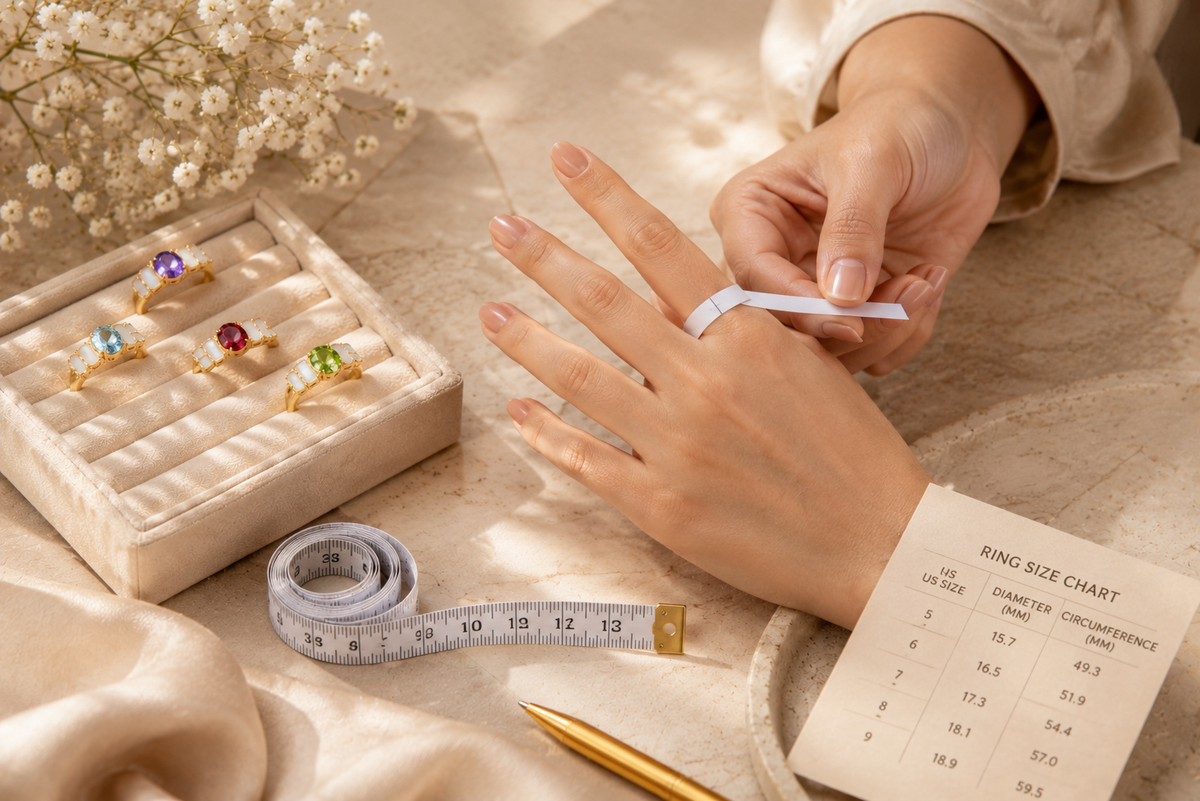
The best way to find your ring size is to measure a ring that already fits the intended finger, or use a proper ring sizer. A paper strip, printable ring size chart, or string method can also give you a useful estimate when used carefully.
A well-fitting ring should move over the knuckle with gentle resistance, rest securely at the base of the finger, and feel comfortable throughout the day. It should not pinch, leave a deep mark, spin constantly, or feel loose enough to slip off.
This guide explains how to measure ring size at home, use a women’s ring size chart, convert between international systems, choose a size for a gift, and understand when an adjustable ring is the more practical choice.
Important fit note: “Women’s ring size” is a shopping category, not a universal body measurement. Ring size varies from person to person, by finger, hand, ring style, temperature, time of day, and even the width of the band.
Executive Summary
The most reliable at-home ring sizing method is to measure the inside diameter of a ring that already fits the same finger on the same hand. If that is not possible, use a non-stretch paper strip or ring sizer to measure finger circumference in millimetres.
For most women’s fashion rings, US sizes 5 to 7 are commonly purchased, but this should only be used as a starting point for gift shopping, never as a final measurement.
For surprise gifts, borrowing an existing ring worn on the correct finger is usually the safest strategy. If the recipient’s size remains uncertain, an adjustable ring can be a thoughtful alternative for a fashion-focused gift.
When buying internationally, always compare the ring’s inner diameter or circumference in millimetres. Number labels can vary by country and retailer, especially in India and across Asian sizing systems.
TL;DR
- Measure an existing ring that fits the same finger for the most dependable at-home result.
- Use millimetres, not guesses.
- A ring should pass over the knuckle with slight resistance and sit comfortably at the finger’s base.
- Measure at the end of the day, at room temperature, and more than once.
- Wider bands and stacked rings may feel tighter than slim bands.
- Do not rely on “average women’s ring size” for an important purchase.
- For a surprise, borrow a ring, ask a trusted friend, or choose an adjustable JEMFYRD ring where suitable.
- Use the product page’s stated sizing information over any generic chart.
What Is a Ring Size?
A ring size is a measurement that corresponds to the inside circumference or inside diameter of a ring.
In the United States, ring sizes are usually expressed in numbers, such as 5, 6, 6.5, or 7. Other markets may use letters, circumference measurements, or region-specific number systems.
The two measurements that matter most are:
| Measurement | What It Means | Why It Helps |
|---|---|---|
| Inner diameter | The distance across the inside of the ring | Best for measuring a ring you already own |
| Inner circumference | The distance around the inside of the ring | Best for measuring your finger with paper or a ring sizer |
| US ring size | Numerical system used in the United States and Canada | Common for online jewellery shopping |
| International size | UK, EU, Indian, Japanese, Chinese, or other system | Useful when purchasing across countries |
For international shopping, millimetres are the most useful common language. A size label can vary by brand, but the inside diameter of a ring remains measurable.
Women’s Ring Size Chart: US Sizes, Diameter and Circumference
Use this chart as a practical reference after measuring your finger or an existing ring.
| US Ring Size | Inside Diameter (mm) | Inside Circumference (mm) |
|---|---|---|
| 3 | 14.1 | 44.2 |
| 3.5 | 14.5 | 45.5 |
| 4 | 14.9 | 46.8 |
| 4.5 | 15.3 | 48.0 |
| 5 | 15.7 | 49.3 |
| 5.5 | 16.1 | 50.6 |
| 6 | 16.5 | 51.9 |
| 6.5 | 16.9 | 53.1 |
| 7 | 17.3 | 54.4 |
| 7.5 | 17.7 | 55.7 |
| 8 | 18.1 | 57.0 |
| 8.5 | 18.5 | 58.3 |
| 9 | 18.9 | 59.5 |
| 9.5 | 19.4 | 60.8 |
| 10 | 19.8 | 62.1 |
Quick answer: If a ring’s inside diameter measures approximately 16.5 mm, it is close to a US size 6. If it measures approximately 17.3 mm, it is close to a US size 7.
What Is the Average Ring Size for Women?
Many women’s rings are purchased in US sizes 5 to 7, with size 6 often used as a rough gift-shopping starting point.
However, average sizing should never replace an actual measurement. Hand shape, knuckle size, preferred fit, ring width, lifestyle, and finger choice all affect the correct size.
Use averages only when every other method is unavailable and the ring can be exchanged, resized, or adjusted.
How to Measure Ring Size at Home
There are four practical ways to measure ring size at home. The best option depends on whether you have access to an existing ring, a printable chart, a ring sizer, or only household items.
Method 1: Measure an Existing Ring That Fits
This is usually the most reliable at-home method.
Choose a ring that:
- Fits comfortably
- Is worn on the same finger
- Is worn on the same hand
- Has a similar band width to the ring you plan to buy
- Is round rather than bent or misshapen
How to measure an existing ring
- Place the ring on a flat surface.
- Use a ruler with millimetres or a digital caliper.
- Measure straight across the inside of the ring.
- Do not include the metal band in the measurement.
- Compare the inner diameter to the chart above.
For example:
- An inside diameter of 15.7 mm is close to a US size 5.
- An inside diameter of 16.5 mm is close to a US size 6.
- An inside diameter of 17.3 mm is close to a US size 7.
JEMFYRD Fit Tip
If you are comparing a ring with a wide statement band to a slim ring you already own, do not assume the same size will feel identical. Wider bands generally feel more fitted against the finger.
Method 2: Measure Your Finger With Paper
A narrow strip of paper is a useful option when you do not have an existing ring.
What you need
- A thin strip of paper
- A pen or pencil
- A ruler marked in millimetres
- The ring size chart above
Step-by-step method
- Cut a thin strip of non-stretch paper.
- Wrap it around the base of the intended finger.
- Make sure the paper is comfortable but not loose.
- Mark where the two ends meet.
- Lay the strip flat and measure the marked length in millimetres.
- Match the measurement to the circumference column in the chart.
For example:
- A circumference of around 51.9 mm is close to US size 6.
- A circumference of around 54.4 mm is close to US size 7.
- A circumference of around 57.0 mm is close to US size 8.
Common mistake to avoid
Do not pull the paper tightly. A tight paper strip can create a ring size that feels uncomfortable in real life.
Method 3: Use a Printable Ring Size Chart
A printable ring size chart is helpful when you already own a ring that fits correctly.
To use a printable ring chart properly:
- Print the file at 100% scale.
- Turn off “fit to page” or automatic resizing.
- Check the included millimetre reference line before measuring.
- Place the existing ring over the printed circles.
- Match the inside edge of the ring to the circle, not the outside edge.
- If the ring falls between two sizes, consider the ring style before deciding.
A printable chart is best used as a confirmation tool, rather than the only measurement method.
Best practice: Measure the ring with a ruler first, then compare it to a printable chart. If both methods point to the same size, your result is more reliable.
Method 4: Use a Ring Sizer
A plastic, metal, or adjustable belt-style ring sizer is one of the most dependable tools for home use.
A proper ring sizer allows you to test how a ring moves over the knuckle and settles at the base of the finger. That makes it more practical than relying only on a flat measurement.
When using a ring sizer:
- Try it on the intended finger.
- Test whether it moves over the knuckle with slight resistance.
- Check that it does not pinch.
- Make sure it does not slide off too easily.
- Test more than one size if you are between sizes.
For a high-value ring, sentimental gift, engagement ring, or ring with a very wide band, professional sizing by a jeweller is still the safest option.
How Should a Ring Fit?
A properly fitted ring should feel secure, comfortable, and natural during normal movement.
Signs your ring fits well
- It slides over the knuckle with a little resistance.
- It rests securely at the finger’s base.
- It does not spin constantly.
- It does not leave a deep indentation after a short period.
- It can be removed without force, discomfort, or soap.
- It feels comfortable when your hands are warm.
Signs your ring is too tight
- It causes tingling, throbbing, or discomfort.
- It creates a deep, persistent indentation.
- It is difficult to remove even when your hands are cool.
- It feels restrictive during daily movement.
- Your finger appears to bulge significantly around the band.
Signs your ring is too loose
- It spins repeatedly.
- It slides around when your hands move.
- It can fall off with a light shake.
- It catches on clothing because it rotates.
- It feels noticeably looser in cool weather.
A ring can feel different throughout the day. The goal is not a perfectly fixed fit at every moment, but a comfortable and secure fit under normal conditions.
Ring Sizing Tips for More Accurate Results
Ring sizing is not static. Fingers naturally change slightly based on temperature, activity, hydration, and time of day.
Use these ring sizing tips before making a final decision.
Measure at the right time
Measure toward the end of the day, when fingers are naturally warmer and may be slightly fuller than in the morning.
Avoid measuring immediately after:
- Exercise
- A hot shower
- A long flight
- Heavy salty meals
- Spending time in very cold weather
- Working with very cold water
Measure more than once
Take at least two or three measurements on different occasions. If the results are slightly different, choose the size that provides a comfortable fit over your knuckle.
Consider the width of the ring band
A thin stacking ring and a wide statement band can feel very different in the same numerical size.
| Ring Style | Typical Fit Consideration |
|---|---|
| Slim band | Usually feels close to true size |
| Wide band | May feel more snug |
| Stacking rings | Multiple rings together can feel tighter |
| Cocktail ring | Weight and top-heavy design can affect movement |
| Open adjustable ring | Allows modest flexibility but still needs careful fitting |
| Eternity-style band | Confirm size carefully because resizing may be limited |
When choosing a wide band, many shoppers prefer to compare the fit with another ring of similar width rather than relying on a slim ring alone.
Ring Size Conversion Chart: US, UK, Europe, India and Japan
International ring sizing can be confusing because countries use different systems.
- The United States and Canada usually use numbers.
- The United Kingdom, Australia, and New Zealand commonly use letters.
- France and many European markets commonly use circumference-based sizing.
- India may use retailer-specific number systems.
- Japan and China often use numerical systems that differ from US sizes.
The safest approach is to compare the inside diameter or circumference in millimetres rather than relying only on size labels.
International Ring Size Conversion Reference
| US Size | Diameter (mm) | Circumference (mm) | Approx. UK Size | Approx. EU / France Size | Approx. Japan Size |
|---|---|---|---|---|---|
| 4 | 14.9 | 46.8 | H | 47 | 7 |
| 5 | 15.7 | 49.3 | J½ | 49 | 9 |
| 6 | 16.5 | 51.9 | L½ | 52 | 12 |
| 7 | 17.3 | 54.4 | N½ | 54–55 | 14 |
| 8 | 18.1 | 57.0 | P½ | 57 | 16 |
| 9 | 18.9 | 59.5 | R½ | 59–60 | 18 |
Important: International conversion tables are approximate references. Always use the specific retailer’s size guide, especially when purchasing from India, China, Japan, or a marketplace seller.
Women’s Ring Sizes in India: What to Know Before Ordering
Indian ring sizing can be especially confusing because many jewellery brands use their own numerical charts.
For example, one brand may label a ring based on inside circumference, while another may use a size number that corresponds to a particular diameter range. Two rings labelled “size 12” may not necessarily match across every Indian jewellery retailer.
To shop confidently:
- Find the ring’s inner diameter in millimetres.
- Check the product page’s stated measurement.
- Compare it with the retailer’s own chart.
- Do not rely only on an India-to-US conversion label.
- Contact the seller before ordering when the purchase is important or non-returnable.
Best rule for global jewellery shopping
Match millimetres first. Match size labels second.
That single approach reduces most international sizing confusion.
How to Find Someone’s Ring Size Secretly
Buying a surprise ring is meaningful, but guessing can feel risky. The best strategy is to collect a real measurement without making the gift obvious.
The surprise ring size decision framework
| Method | Accuracy | Best For | Watch Out For |
|---|---|---|---|
| Borrow an existing ring | High | Partner, spouse, close family member | It must be worn on the same finger |
| Trace the inside of a ring | Medium to high | When you cannot take the ring away | Trace the inside edge carefully |
| Measure the ring’s diameter | High | When you can borrow it briefly | Do not measure the outer edge |
| Ask a close friend or family member | Medium | Birthdays, anniversaries, proposals | They may not know the exact finger size |
| Ask indirectly during shopping | Medium | Fashion gifts | Avoid making the surprise obvious |
| Use an adjustable ring | Practical | Fashion-forward gifts | Not ideal for every ring style |
| Guess from average sizes | Low | Last-resort situations only | Use only with exchange flexibility |
Best method: borrow a ring they already wear
Look for a ring they wear regularly on the intended finger. The ring finger on the right hand may not match the ring finger on the left hand, so confirm which finger the new ring is meant for.
Once you have the ring:
- Place it on a printable chart.
- Measure the inside diameter in millimetres.
- Trace the inside circle on paper.
- Take it to a local jeweller for confirmation if the occasion is especially important.
Ask their inner circle
A sibling, best friend, roommate, or parent may know more than you expect. They may also be able to bring up ring sizes naturally while shopping or discussing accessories.
Use adjustable rings when appropriate
Adjustable rings can be a thoughtful option for fashion jewellery gifts when you do not know the recipient’s exact size.
They are especially useful for:
- Birthdays
- Holidays
- Mother’s Day
- Valentine’s Day
- Friendship gifts
- Festival gifting
- First jewellery gifts
- Statement gemstone styles
JEMFYRD’s Women Rings collection includes adjustable gemstone and brass ring styles, making them a practical option when a surprise gift matters more than a fixed-size fit.
Adjustable-ring note: An adjustable ring is designed for modest fit flexibility. It should not be pulled open and closed repeatedly or forced far beyond its intended range.
Ring Size Calculator: How to Calculate Your Size From Circumference
A ring size calculator converts your finger circumference into an approximate ring size.
The basic formula is:
Diameter = Circumference ÷ 3.14
For example:
- If your paper strip measures 51.9 mm around your finger:
- 51.9 ÷ 3.14 = approximately 16.5 mm diameter
- A 16.5 mm diameter is close to a US size 6
You do not need to calculate this manually if you use the chart in this guide. The formula simply explains why circumference and diameter can both be used to identify ring size.
Should You Size Up or Down If You Are Between Sizes?
When you are between sizes, do not automatically size up or down. First consider the ring style, your knuckle, and your preferred fit.
Choose the larger size when:
- The ring has a wide band.
- Your knuckle is noticeably larger than the base of your finger.
- You are measuring in cold conditions.
- You plan to stack the ring with others.
- The ring needs to pass comfortably over a prominent knuckle.
- The smaller size feels restrictive.
Choose the smaller size when:
- The ring is very slim and spins easily.
- Your fingers are often cool.
- The larger size feels unstable.
- The ring has a top-heavy stone and rotates excessively.
- You are comparing it to a thin everyday ring.
For most fashion rings, comfort and security matter more than chasing a perfect numerical label.
Can Adjustable Rings Replace Standard Ring Sizing?
Not always. Adjustable rings are helpful, but they are not a universal substitute for a correctly sized fixed-band ring.
Adjustable rings are a good choice when:
- You are buying a surprise gift.
- The recipient’s size is uncertain.
- The design is intentionally open-ended.
- The ring is a fashion statement rather than a formal commitment ring.
- The wearer likes to switch fingers occasionally.
Fixed-size rings are usually better when:
- The ring will be worn every day.
- The ring has a continuous band.
- The ring has a precise stone setting.
- The ring is intended as an engagement, wedding, or heirloom piece.
- The design cannot be safely adjusted.
The right choice depends on the occasion, design, and confidence level around sizing.
Body Jewelry Ring Sizing Is Different From Finger Ring Sizing
A standard women’s ring size chart is designed for finger rings. It should not be used to size body jewellery such as nose rings, septum rings, belly rings, ear hoops, or other piercing jewellery.
Body jewellery sizing typically depends on:
- Gauge or thickness
- Internal diameter
- Length
- Placement
- Anatomy
- Healing stage
- Piercing professional guidance
For body jewellery, always use the product’s stated gauge and millimetre dimensions. A US size 6 finger ring does not translate to a nose ring, hoop earring, or body piercing ring.
Printable Ring Size Chart Checklist
Before relying on a printable ring size chart, check the following:
- The file is printed at 100% scale.
- “Fit to page” is turned off.
- The millimetre reference line is accurate.
- You are measuring a ring that fits the intended finger.
- You are matching the inside edge of the ring.
- The ring is round and not bent.
- You measured twice using another method.
- You checked the product page for any style-specific sizing notes.
JEMFYRD Ring Buying Checklist
Before adding a ring to your cart, ask:
- Which finger will the ring be worn on?
- Have I measured that exact finger or a ring worn on it?
- Is the band slim, wide, stacked, or adjustable?
- Does the product page list a fixed size or adjustable design?
- Am I buying for myself or as a surprise gift?
- Do I need a size-flexible option?
- Have I checked the care and material information?
- Have I reviewed the return, exchange, or support guidance before ordering?
For a gift where the size is uncertain, consider an adjustable gemstone or brass ring from JEMFYRD’s Women Rings collection, then pair it with a necklace, earrings, or bracelet for a more complete jewellery gift.